JIGANG LI*, Undergraduate Student, Dept. of Film and Visual Effects, Dongseo University
Busan, Korea (south), 1319927944@qq.com
ZHANG ANNI, Undergraduate Student, Dept. of Film and Visual Effects, Dongseo University
Busan, Korea (south)
CHENSHI YUXIN, Undergraduate Student, Dept. of Film and Visual Effects, Dongseo University
Busan, Korea (south)
LIU YOUMING, Undergraduate Student, Dept. of Film and Visual Effects, Dongseo University
Busan, Korea (south)
XIONG YIWEN, Undergraduate Student, Dept. of Animation, Dongseo University
Busan, Korea (south)
KIM DOHOON, Assistant Professor, Dept. of Animation, Dongseo University
Busan, Korea (south)
* Corresponding author
Abstract — This paper reports how a five-person student team produced If We Were Them (《如果是你》), a 7.5-minute sci-fi short film, with generative AI tools from script to final cut. We used ChatGPT for concept design, asset images, storyboard frames and video prompts, and generated the moving shots on the HiggsField platform with the Kling 3.0 image-to-video model. The film turns a real event—the fact that the last two northern white rhinos are a mother and daughter—into a role-reversal fable in which the last two humans are repeatedly experimented on by a more advanced civilization. Two design decisions shaped the whole film: a high civilization whose look grows out of the white rhino, and a vegetation-dominated wasteland style for the post-apocalyptic world. The most valuable lesson concerned storyboarding: very detailed instructions repeatedly produced frames that failed to match our expectations and cost us a large share of the schedule, while simplified prompts let the model interpret each scene and produced noticeably better storyboards. The paper describes the full pipeline and our solutions to the main difficulties, and may serve as a practical reference for other small teams.
Keywords — Ai Filmmaking; Text-To-Image; Text-To-Video; Storyboarding; Prompt Design; Short Film Production; Chatgpt; Kling 3.0
I. Introduction
Generative AI has quickly moved from a novelty to a practical production tool[1]. Text-to-image and text-to-video systems allow a small team to create shots that would once have required a full art department, which is why AI-assisted filmmaking attracts growing interest among students and independent creators[2][3][4]. Yet most published discussions focus on single tools or isolated prompt tricks; detailed reports of complete productions remain rare, so teams still figure out workflows and failure points largely by trial and error.
Our project started from a real story. The last two northern white rhinos in the world are a mother and her daughter, and humans have been trying to save the subspecies through assisted reproduction for years[5][6]. From this we developed a role-reversal question: if humanity became an endangered species, kept alive and experimented on by a more advanced civilization, would we still find how we treat the rhinos acceptable? This became the concept of If We Were Them, a future sci-fi allegory about the last human mother and daughter. The short-term objective of this paper is to document the production workflow, the design decisions and the problems we encountered; the longer-term goal is to add a concrete case to the practical knowledge of AI-assisted filmmaking.
II. Project Setup
The film was made by a five-person team. The director handled daily planning, style control, storyboards and the poster; the screenwriter and editor wrote the script and assembled footage, background music, sound effects and dialogue; the rest of the team generated storyboard images and video clips and produced music, sound effects and voiceovers. The final film is 2K resolution, 7 minutes and 30 seconds long, in the sci-fi drama genre.
III. Production Pipeline
We followed a seven-stage pipeline: script making, storyboarding, concept design, scene image generation, image-to-video, dubbing and sound, and editing and compositing. The script was written first, based on the white rhino event, and organized in a three-act structure that moves from the future sci-fi world to an open ending and then back to reality. At the end of the film the audience discovers that the entire fable has been mirroring the real mother-daughter rhino pair, which reveals the theme. All still images in the pipeline were generated with ChatGPT[7]. For the image-to-video stage we used the Kling 3.0 model on the HiggsField platform, feeding the generated scene images as first frames together with motion prompts, and iterating until the movement was acceptable[8].
IV. Concept Design
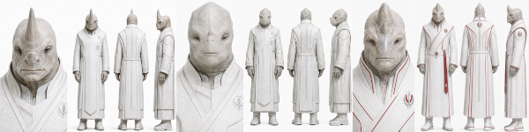
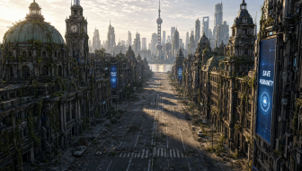
Two visual decisions fixed the look of the film. First, because the high civilization is the moral counterpart of human researchers in our own world, we built their appearance directly on the white rhino: the researchers are humanoid figures with a single rhino-like horn, dressed in long white robes, which gives them a calm, ceremonial and slightly unsettling presence. Second, because the story takes place after humanity has gone extinct, we set the overall environment style as a vegetation-dominated wasteland: plants reclaim the streets of Shanghai, ruins stand beside high-tech architecture, and glowing billboards still repeat slogans such as "SAVE HUMANITY" to empty roads. The same logic was applied to the main characters. The last human male, Adam, wears a worn researcher-style jacket, the daughter has casual everyday outfits and a light pajama look for home scenes, and the mother appears in soft cardigan sets, so that the "last humans" feel ordinary rather than heroic. The key sets follow the same contrast: a warm home interior with a circular window overlooking the ruined city, and a cold, white medical laboratory with holographic displays, gene-chain screens and red floor markings where the experiments take place.
V. Storyboarding: an Adjustment in Method
Storyboarding was the most difficult stage. Our first approach was to give ChatGPT extremely detailed instructions for every frame: shot type, framing, character position, camera movement, lighting, and the exact action. In theory this should give the most control, but the generated frames kept failing to match the intended composition, and we spent a large part of the schedule re-prompting and correcting. The turning point came when we reduced the amount of detail on purpose and let the model decide how to stage each scene. With a short description of the scene goal and the key action, ChatGPT produced storyboard frames that were cleaner, more varied and much closer to what the director imagined. From then on we treated storyboarding as an interpretative step: we kept detailed constraints where control really mattered, such as character appearance, and gave the model freedom for composition and mood.
VI. Handling of the Main Difficulties
Four difficulties recurred during production. To keep character appearance consistent across different shots and lighting conditions, we built a character feature prompt library reused in every generation. To avoid the flat lighting AI images tend to have, we added explicit light-source descriptions to the prompts and enhanced lighting in post-production. Special shots, such as the "door crack" perspective in the key scene, were achieved by writing prompts that describe the viewing perspective rather than the object itself. Finally, unstable footage from the video model was corrected with video stabilization tools during editing.
VII. Results
The production delivered concept sheets, storyboard frames, scene images, a poster, and the final 2K film of 7 minutes and 30 seconds. The design outcomes are shown in the figures below.
The high civilization design produced three variants of the rhino-inspired researcher, all carrying the single horn and the long white robe, with details ranging from a plain robe to a red-trimmed ceremonial version (Figure 1).
The environment design established the vegetation-dominated wasteland: the skyline of Shanghai with the Oriental Pearl Tower standing among overgrown ruins, and city screens still broadcasting survival slogans (Figure 2).
The character sheets fixed the appearances of the last human mother, daughter and Adam across their everyday costumes (Figure 3).
The film stills show how these designs carried into the actual shots (Figure 4).
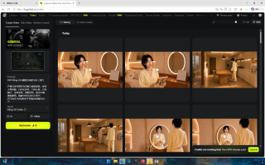
The image-to-video stage produced the moving shots on the HiggsField platform using the Kling 3.0 model (Figure 5).
The most significant result concerned the storyboard problem. After we switched from over-detailed prompts to simplified ones, usable frames appeared within far fewer iterations, and the storyboard phase, which had threatened to delay the whole production, moved forward at a stable pace. We did not measure the effect formally, but the change in success rate was obvious to everyone on the team and it changed how we wrote prompts for the rest of the pipeline. The other solutions also worked in practice: the character prompt library kept the three leads recognizable from shot to shot, the light-source prompts visibly improved the indoor and laboratory scenes, the door-crack shot matched the script after the perspective-based prompt, and the stabilization pass removed most of the visible shaking from the generated footage.
VIII. Discussion and Conclusion
The storyboard result goes against the common assumption that more detailed prompts always mean more control[9][10]. In our experience, very detailed prompts push the model to satisfy every constraint at once; when constraints conflict, the output becomes generic, crowded or poorly composed, and small corrections do not fix it. A simplified prompt, by contrast, gives the model room to use what it has learned about cinematic composition, so the frame reads better even if the model has interpreted some details itself. The lesson is to treat generative tools as interpretative collaborators rather than precise executors: keep instructions strict where consistency really matters, such as character identity, and let the model improvise where visual judgement matters, such as staging and mood. This finding is directly useful to other small teams, since storyboarding is usually the first place where prompt management problems appear.
This study has clear limitations. It is a single case from one student team, the evaluation of image quality is subjective, and both the models and the platforms we used change quickly, so the specific results may not transfer to newer versions. What we hope transfers is the general workflow and the way of thinking about prompts. In summary, a five-person team produced a complete 7.5-minute AI short film with a seven-stage pipeline around ChatGPT and Kling 3.0 on the HiggsField platform, and we learned through a costly failure that reducing the detail in storyboard prompts produces better results. As generative tools become a normal part of filmmaking, practical reports like this can help creators spend their time on storytelling rather than on fighting the tools.
Figure 1. Figure 1. Concept design of the high civilization: three variants of the rhino-inspired researcher in white robes.Figure 2. Figure 2. Environment concept of the film: a vegetation-dominated wasteland in the ruins of Shanghai, with the “SAVE HUMANITY” billboard.Figure 3. Figure 3. Character sheets for the three leads: Adam, the daughter and the mother.Figure 4. Figure 4. Film stills from the final cut: the opening chase, a domestic scene and the laboratory.Figure 5. Figure 5. Image-to-video generation on the HiggsField platform with the Kling 3.0 model.
References
[1] OpenAI, “Video generation models as world simulators,” OpenAI Technical Report, Feb. 2024. [Online]. Available: https://openai.com/index/video-generation-models-as-world-simulators/
[2] R. Rombach, A. Blattmann, D. Lorenz, P. Esser, and B. Ommer, “High-Resolution Image Synthesis with Latent Diffusion Models,” in 2022 IEEE/CVF Conference on Computer Vision and Pattern Recognition (CVPR), 2022, pp. 10674–10685, doi: 10.1109/CVPR52688.2022.01042.
[3] U. Singer, A. Polyak, T. Hayes, et al., “Make-A-Video: Text-to-Video Generation without Text-Video Data,” arXiv preprint arXiv:2209.14792, 2022.
[4] Y. Liu, K. Zhang, Y. Li, et al., “Sora: A Review on Background, Technology, Limitations, and Opportunities of Large Vision Models,” arXiv preprint arXiv:2402.17177, 2024.
[5] T. Tunstall, R. Kock, J. Vahala, et al., “Evaluating recovery potential of the northern white rhinoceros from cryopreserved somatic cells,” Genome Research, vol. 28, no. 6, pp. 780–788, 2018, doi: 10.1101/gr.227603.117.
[6] M. L. Korody and T. B. Hildebrandt, “Progress toward genetic rescue of the northern white rhinoceros (Ceratotherium simum cottoni),” Annual Review of Animal Biosciences, vol. 13, pp. 483–505, 2025, doi: 10.1146/annurev-animal-111523-102158.
[9] J. Oppenlaender, “A taxonomy of prompt modifiers for text-to-image generation,” Behaviour & Information Technology, vol. 43, no. 15, pp. 3763–3776, 2024, doi: 10.1080/0144929X.2023.2286532.
[10] V. Liu and L. B. Chilton, “Design Guidelines for Prompt Engineering Text-to-Image Generative Models,” in Proceedings of the 2022 CHI Conference on Human Factors in Computing Systems (CHI '22), ACM, New York, NY, USA, 2022, Article 349, pp. 1–16, doi: 10.1145/3491102.3501825.