TO DAY: Directorial Practice in AI-Assisted Filmmaking
CHEN GUANWEN*, Undergraduate Student, Dept. of Film and Visual Effects, Dongseo University
China, 3317201688@qq.com
WU JIAMIN*, Undergraduate Student, Dept. of Film and Visual Effects, Dongseo University
China, wujiaming151@gmail.com
GUO CHENGZE*, Undergraduate Student, Dept. of Film and Visual Effects, Dongseo University
China, wuanddian@gmail.com
KIM SOJIN*, Assistant Professor, Dept. of Animation, Dongseo University
Korea (south), sojinkim@gdsu.dongseo.ac.kr
* Corresponding author
Abstract — This paper examines TO DAY, an AI-generated science-fiction short film, from the perspective of the director and screenwriter. Through a narrative about humanity losing the ability to form long-term memories, the film explores memory, trust, and the continuity of civilization. This paper outlines the film’s creative concept, narrative structure, and AI-assisted production workflow using GPT, Higgsfield, Kling, and Suno. It also discusses the technical limitations of AI-generated video, particularly the dependence of first-and-last-frame generation on image quality and consistency. The production experience demonstrates that although generative AI expands the possibilities of filmmaking, directorial judgment remains essential to achieving visual continuity and coherent storytelling.
Keywords — Ai Short Film;Generative Artificial Intelligence;Visual Storytelling
I. Introduction
TO DAY is a science-fiction short film based on a mysterious solar radiation pulse that causes humanity
to lose the ability to form new long-term memories. Although time continues to pass, people can no
longer remember yesterday, leading to the gradual breakdown of social order.
The film follows three narrative stages: Fracture, Reconstruction, and Transcendence. The first depicts
the collapse of society caused by memory loss. The second presents humanity’s attempt to preserve
knowledge and maintain cooperation through recording. The third extends the story into deep-space
exploration, where external memory systems allow humanity to continue its development.
The central question is: If individuals cannot preserve today, can civilization still have a tomorrow?
The concept of the “Reverse Tower of Babel” also inspired the project. Rather than losing language,
humanity loses the continuity of experience. Written records consequently become a means of preserving
shared knowledge and rebuilding trust. Through this concept, the film explores how civilization can
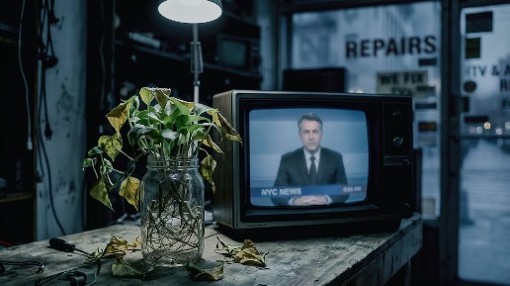
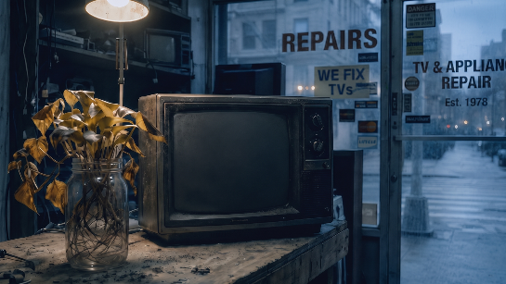
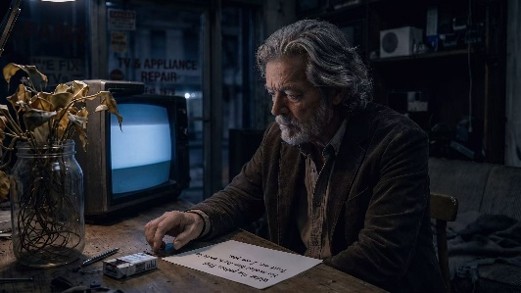
continue when individual memory is no longer reliable. Figure 1、2 presents an AI-generated visual example
of the film’s abandoned-world setting.
Figure 1. AI-generated scenes depicting an abandoned repair shop and a television broadcast.Figure 2. AI-generated scenes depicting an abandoned repair shop and a television broadcast.
II. Production Methods
In generative AI filmmaking, prompts function not merely as technical instructions but also as a means
of translating creative intentions into visual compositions and cinematic scenes (Ha, 2026).
[1]
As the
director and screenwriter, the author was responsible for the story, screenplay, visual direction, and
overall organization of the film. AI tools were used to assist with image generation, video production,
and music composition.
ChatGPT was used to assist in generating static images. Higgsfield and Kling were then used to transform
these images into dynamic shots through prompts and a first-and-last-frame workflow. By defining the
beginning and ending frames, the author could guide the intended visual development of each shot. Suno
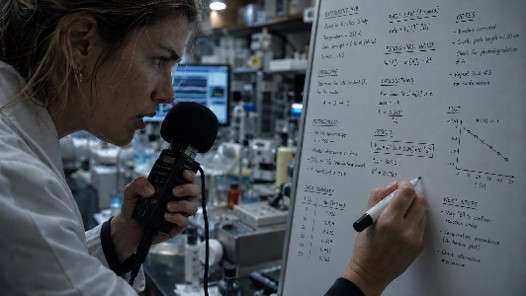
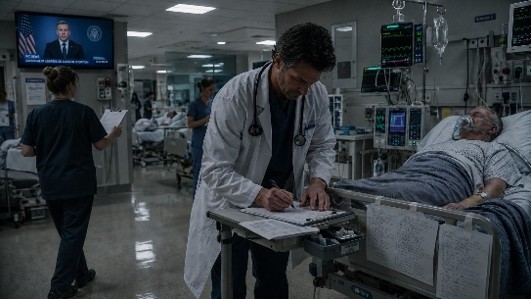
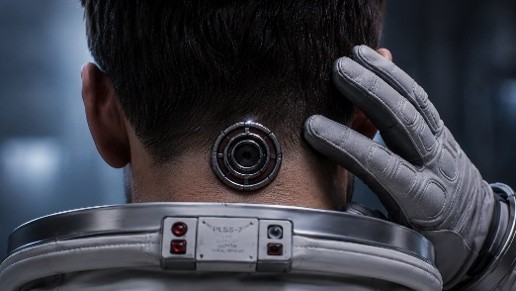
was used to generate music, which was integrated into the film during post-production. Figures 3、4、5、6 present
examples of AI-generated visual materials developed for the film.
The production workflow consisted of screenplay development, image generation, first-and-last-frame
design, video generation, music creation, and final editing.
This process allowed the author to create a science-fiction film without conventional location shooting.
However, it also required repeated adjustments to images and generated footage to maintain visual
consistency and narrative continuity.
Figure 3. AI-generated scenes illustrating the film’s memory-loss crisis and its effects on survivors.Figure 4. AI-generated scenes illustrating the film’s memory-loss crisis and its effects on survivors.Figure 5. AI-generated scenes illustrating the film’s memory-loss crisis and its effects on survivors.Figure 6. AI-generated scenes illustrating the film’s memory-loss crisis and its effects on survivors.
III. Results and Technical Limitations
The production demonstrated that generative AI can support the creation of individual cinematic shots
and the assembly of a complete narrative film. However, generating visually convincing images does not
necessarily guarantee coherent motion.
A major challenge was the dependence of first-and-last-frame generation on the quality of the source
images. If either frame contained visual defects, or if the two frames differed significantly in character
appearance, composition, or spatial relationships, the resulting video could exhibit unnatural movement,
changes in character appearance, inconsistent backgrounds, or visibly fragmented transitions.
These problems indicate that image generation and video generation are closely connected stages. The
quality of the initial images directly affects the possibilities and limitations of the subsequent motion.
Therefore, careful image preparation, prompt refinement, and selective regeneration are necessary to
improve the final result. Figure 4 shows one example of a generated detail that required visual
consistency with the surrounding shots.
In addition, AI-generated footage may contain inconsistencies that become more noticeable when
individual shots are assembled. Post-production editing is therefore important for maintaining pacing,
continuity, and the overall visual coherence of the film.
IV. Discussion and Conclusion
In AI-assisted filmmaking, directorial authorship can be understood through the establishment of creative
intentions, the selection and editing of generated materials, and the organization of visual elements (Jung,
2026).
[2]The production of TO DAY demonstrates that generative AI can expand the creative possibilities
available to filmmakers, but it does not eliminate the need for directorial control.
Although AI tools can generate images, motion, and music, the results do not always match the creator’s
intentions. The director must evaluate the generated material, identify technical problems, decide which
shots require regeneration, and organize the selected footage into a coherent narrative.
The first-and-last-frame workflow makes this responsibility particularly clear. The quality and
consistency of the source images influence the continuity of the resulting motion, meaning that visual
planning remains essential even when AI performs much of the image generation.
As the director and screenwriter, the author concludes that AI-assisted filmmaking depends not only on
the capabilities of the tools but also on the creator’s ability to guide and evaluate their outputs. AI
provides new methods of visual production, while the director remains responsible for connecting these methods to narrative intention and artistic expression.
Through TO DAY, the author explored both the creative potential and the technical limitations of
generative AI. Future development in AI filmmaking should focus not only on improving image
generation but also on achieving greater consistency and control across the entire filmmaking process.
References
[1] Ha, Jung-hyun. (2026). Prompt-Stylo: Film Creation in the Age of Generative AI and the Redefinition of Authorial Subjectivity. Cineforum, 53, 9–40.
[2] Jung, Hye-won. (2026). Film Authorship in the Age of Generative AI: Directors, Creative Labor, and Institutional Recognition. Film Studies, 109, 535–578.