Bio-Inspired Adaptive Ensemble for Smart Fertilizer Recommendation
Abstract — Soil nutrients are variable with weather and past crops; so farmers are always trying to guess how much fertilizer they need for their crop. Applying the incorrect rate of fertilizer is an unnecessary expense, damage to the crops and pollution of the environment. This paper proposes a data-driven recommendation framework which will read live soil data from Internet of Things (IoT) sensors like temperature, moisture, acidity level (pH), and the three main nutrients Nitrogen (N), Phosphorus (P) and Potassium (K) and can support fertilizer-category recommendations what fertilizer type to use. A large number of soil records (98616) were collected, and we tested seven popular machine learning models: K-Nearest Neighbors (KNN), Logistic Regression, Support Vector Machine (SVM), Decision Tree, Random Forest, XGBoost and LightGBM. We then created a new combined model, which we dubbed Bio-Inspired Adaptive Ensemble, and which combines "the best three" models (Random Forest, XGBoost and LightGBM) in a way that automatically learns to trust three models by using an algorithm inspired by nature, called Particle Swarm Optimization (PSO). The overall accuracy of the proposed ensemble was 91.72% which was comparable to the strongest individual models tested. Results indicate that using multiple models with a smart, adaptive weighting method provides more reliable and more accurate fertilizer recommendations and can help to create precision-farming systems that are affordable and scalable for actual farms.
Keywords — Precision Agriculture, Iot Soil Sensors; Fertilizer Recommendation; Machine Learning; Ensemble Learning; Particle Swarm Optimization; Soil Nutrient Analysis.
I. Introduction
The use of precision agriculture and efficient nutrient management, as well as soil-health preservation, is increasingly crucial to agricultural productivity. Excessive fertilizer use can result in higher production expenses, nutrient imbalances, and/or greater nutrient runoff to the environment. Traditional fertilizer management techniques may not fully consider soil, climate and crop nutrient demands. Thus, data-driven techniques, which help the selection of the most suitable fertilizer based on soil and environmental measurements, are of great importance for more informed agricultural decision-support systems.
Most modern farms today determine fertilizer quantities by experience, tradition, or by applying simple soil testing apparatus that provide only a general indication of soil fertility. This speculation can frequently cause two types of errors. Too much fertilizer (over-fertilization) causes excess chemicals to run off into rivers, lakes, streams and ground water and costing the farmer additional money as well as damaging the environment. Too little (under-fertilization) results in the crop not getting the nutrients it requires and the crop yield is reduced. Both errors are damaging farmers' bottom line and the environment.
The Internet of Things (IoT) is the way to resolve this data issue. Now, small, cheap sensors are able to be embedded in the ground to monitor soil moisture, temperature and pH, as well as nutrients, on the spot. But raw sensor data is not significant to an average farmer. A screen reading of “Nitrogen = 40, pH = 6.5” does not tell a farmer which bag of fertilizer to purchase. That is what is needed - a system that can read these numbers and turn them into a simple, clear recommendation for what to do, as an expert agronomist would.
Seminal ContributionsThe purpose of this study is to explore a machine learning approach to categorize fertilizers based on soil and environmental characteristics that can be acquired or represented as part of an IoT-inspired data pipeline. The proposed approach combines the Random Forest (RF), Extreme Gradient Boosting (XGBoost) and Light Gradient Boosting Machine (LightGBM) using Particle Swarm Optimization (PSO) for the purpose of weighting. The framework classifies the input features into one of six classes of fertilizers that are pre-defined. It does not directly estimate fertilizer dosage or application rates and this needs extra agronomic information such as crop, growth stage, field conditions, nutrient-management requirements, etc.
The importance of good soil health extends beyond the farm. Excess fertilization can result in excess chemicals entering waterways such as rivers, lakes and ground water in rainy conditions. This may have adverse effects on fish and other wildlife and may even impact the drinking water supplies of nearby towns. However, over time, lack of nutrients results in a gradual decline in the natural fertility of the soil, making it more difficult to obtain high-quality crops in subsequent seasons. A system which provides the correct fertilizer recommendation at the right time therefore not only supports the farmer's livelihood, but also helps in maintaining the water quality and soil health over a long period of time.
It's also interesting to note why machine learning is the appropriate tool to solve this problem, rather than just a fixed rulebook. A rulebook approach would suggest for example to use Urea if the N value is below 30, but in reality, soils do not behave like rules. If the soil has a low Nitrogen and very high organic carbon, then there's a possibility that there may be no need for additional Urea, as the soil can be naturally releasing nutrients over time.
This paper has the following main contributions:
An integrated soil-feature pipeline with nutrient-balance ratios as a representation of the relationships between nitrogen, phosphorus, and potassium measures.
An ensemble of three models (Random Forest, XGBoost, LightGBM) combined by probability, optimized by Particle Swarm Optimization.
Comparative study with seven standard machine learning classifiers with overall and class wise performance metrics.
Classification limitations analysis, especially performance of less-represented categories of fertilizer, to determine the needs for additional validation and deployment.
The remainder of this paper is organized as follows: Section II gives a review of the related work in the fertilizer recommendation in the IoT-based and machine learning-based approach. In section III, the proposed system and its step-by-step working are explained. The data set used for training and testing are described in Section IV. The results are presented and discussed in Section V. The paper is concluded in Section VI, with future improvements are made.
II. Literature Review
Sundaresan et al. proposed An integrated smart farming system comprising three modules, namely "crop recommendation", "automatic irrigation" and "fertilizer recommendation" is developed. The data from these IoT sensors is used to determine the nutrient, pH, moisture, and weather conditions in the soil, and machine learning algorithms interpret the information to make informed suggestions about what crops to plant and when. The integrated system minimizes manual workload, saves water and facilitates management of fertilizers. The simulations show that the proposed approach is capable of improving the farming efficiency and farm yield [1].
IoT-Based Soil Monitoring and Agricultural Decision SupportIn the field of agriculture, the use of Internet of Things (IoT) technologies to monitor soil and environmental properties, such as moisture, pH, temperature, and nutrient-related properties, has been studied. Current systems combine sensor networks with data-processing platforms to aid soil analysis, the selection of crops, irrigation management and fertilizer recommendation [2]–[6]. While these approaches highlight the potential of agricultural decision support with sensor data, the success of such approaches relies on sensor reliability and quality of the data, connectivity, and input representativeness of the measurements. In addition, it is not enough to take soil samples to simply determine if a fertilizer is recommended. A predictive model has to understand the attributes at hand and must be tested with a well-defined recommendation target.
Machine Learning for Fertilizer RecommendationSoil and environmental characteristics have been used for agriculture classification and recommendation using machine-learning techniques. A number of studies considered in this manuscript explore methods such as the K-nearest neighbors (KNN), support vector machines (SVM) [7] – [11], decision trees [12] and probabilistic classifiers [13]. Tree-based methods and boosting algorithms can capture the nonlinear relationships between the input features, while distance-based and linear classifiers offer other decision-making mechanisms. Despite this, the results reported are dataset dependent, feature dependent, class dependent and protocol dependent. Thus, one should not directly compare the accuracy values from different datasets without taking into consideration the differences in their labels, partitions of data and their evaluation measures.
Ensemble Learning and Bio-Inspired OptimizationEnsemble learning: The predictions of multiple classifiers are combined to make use of complementary decision patterns. But the strength of an ensemble relies on the predictive ability and diversity of individual models within the ensemble, and on how the outputs of the individual models are combined. Uniform probability averaging gives equal weight to each of the classifiers that participate in the test, weighted aggregation gives more weight to some classifiers than others. PSO is a population-based optimization mechanism which can be applied for searching a suitable ensemble weights to a given validation objective. The resulting weights should be learned without using the held out test data, to prevent an over-optimistic estimate of performance.
Research Gap and MotivationThe studied literature encompassed soil monitoring, using IoT, agricultural recommendations using machine learning, and various classification approaches. So far, the literature review in the present manuscript does not provide evidence of a PSO-weighted combination of Random Forest, XGBoost and LightGBM having been sufficiently assessed for the six categories of fertilizers used in this study. The study investigated that particular ensemble configuration and compared it with seven conventional classifiers reported. Class-wise performance is also taken into account as a high accuracy overall can mask poor predictions for less representative fertilisers. The contribution is not in the proposed configuration and its empirical evaluation, but in the introduction of ensemble learning or PSO as new techniques.
Recent closely related research includes independent fertilizer and crop recommendation using interpretable deep learning [14], AIoT-based soil nutrient analysis and crop recommendation [15], and a comparison of soil-nutrient prediction models optimized with PSO, genetic algorithms, and Bayesian optimization [16]. A 2026 IEEE study evaluates hybrid crop/fertilizer recommendation systems against PSO-based optimizers and incorporates explainability and IoT-based field validation [17]. These studies reinforce the need to compare optimization strategies on common data partitions and to distinguish fertilizer-category classification from agronomically validated fertilizer application rates. Tanaka et al. [18] further demonstrate that predictive accuracy alone does not establish accurate fertilizer-rate recommendations.
III. Proposed Methodology
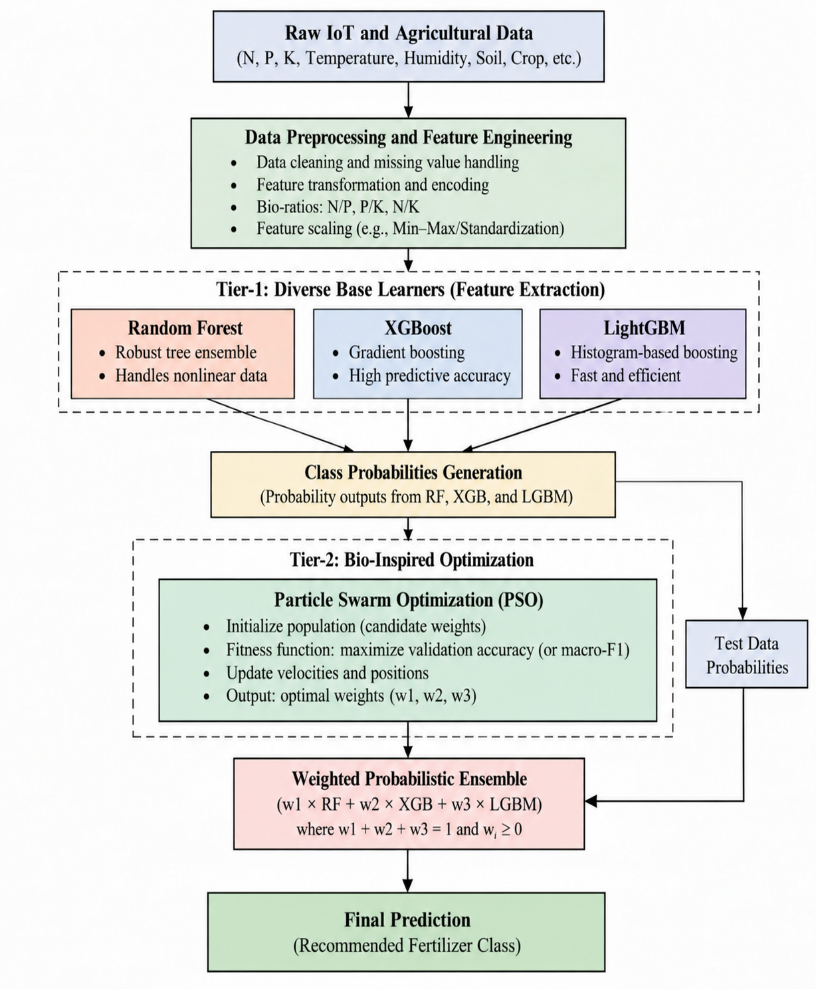
Fig. 1 shows the complete working of the proposed system. The first data that comes in is from the farm sensors and basic farm records. This data is cleaned and turned into useful features. Three separate machine learning models are then applied to the same data and each model provides its own opinion (known as a class probability) about what fertilizer is required. An optimization step, inspired by nature, then determines the weights, or confidence, with which each of the three opinions should be considered, and uses them to arrive at a final opinion with even more confidence. These steps are detailed in the sub-sections below.
Dataset Preprocessing and Feature EngineeringThe raw data from the sensors needs to be processed before it can be used by any machine learning model. First, all text values (e.g., names of soil types) are translated into a number that can be interpreted by the computer. For numerical attributes, missing values were handled using the median of the corresponding feature, while categorical attributes were imputed using the most frequent category. Duplicate records were removed before dataset partitioning to reduce redundant observations and the risk of information leakage Second, all numeric readings are kept to a comparable and narrow range: a hundred of measurements on the scale of rainfall in mm does not lead to an unfair domination by a small number on the scale of pH. Third and most importantly, we will be calculating two basic “biological ratios” that represent the nutrient balance, Nitrogen-to-Phosphorus ratio (N/P) and Phosphorus-to-Potassium ratio (P/K). The ratios are important because plants just can't use one nutrient in huge quantities; the nutrients have to be in the proper proportion to one another. During this division a very small number is also added to avoid the division ever becoming undefined when a reading is 0. The dataset was partitioned into training and held-out test subsets using an 80:20 stratified split. Within the 80% training partition, an internal validation subset is required to optimize the ensemble weights without accessing the held-out 20% test partition. The base classifiers are fitted on training data, PSO selects weights using internal validation predictions, and the held-out test partition is reserved for final evaluation. The precise internal validation allocation has not been documented.
Tier-1: Diverse Base LearnersAt the same time, the cleaned data is fed into three different “expert” machine learning models. These models each interpret the data differently and hence, work well in tandem.
Random Forest (RF): creates multiple small decision trees and allows them to vote, which makes it very robust to noisy or abnormal sensor data.
XGBoost (XGB): Tries to correct the errors of the previous tree to build it one after another, achieving very high accuracy.
LightGBM (LGBM): a speedier and more efficient version of gradient boosting, especially on large datasets such as the 98,616-record data set in this research.
All three models score the probability of each fertilizer class, indicating the confidence that the model has in each.
Tier-2: Bio-Inspired Weight Optimization (PSO)After the three expert models have voted, the system must determine the level of trust that is to be put into each of them. This is accomplished by an algorithm called particle swarm optimization (PSO) which mimics the behavior of a flock of birds in finding food. Many particles (a combination of candidate weights) are tested simultaneously in PSO. Each particle has a set of three weight values w1, w2, and w3 with which to mix the three models' opinions. Each particle evaluates its own mixture validation accuracy on a validation set of soil data, and then self- and swarm-particle-movement adjusts its position slightly closer to the optimal mixture achieved by the group of particles and by itself. After many rounds, the swarm sticks to the combination of weights that yields the highest accuracy. This is stronger than just taking the average of the three models, since PSO can learn that, e.g., XGBoost, should be trusted a little more than the other two, for this particular dataset.
In simple terms, the final ensemble prediction is a weighted sum of the outputs of the three base classifiers as given in equation (1) where PRF, PXGB, and PLGBM are the class probabilities generated by random forest, XGBoost and LightGBM, while w1, w2, and w3 are the trust weights obtained using PSO.
Equation (2) specifies the validation-based optimization objective and its feasible weight constraints.
Here, each P is a probability vector over the six fertilizer categories.
In this study the swarm consisted of 30 particles which were expected to search as a group for 50 rounds (iterations). The position of each particle corresponds to one set of weights (w1, w2, w3) and the “fitness” of each particle is simply the accuracy of the mixed prediction on the validation data. The 50 rounds of swarms were sufficient for the swarm to settle down and stop improving, demonstrating that the search didn't end too soon and that the swarm had converged on a stable, good answer, rather than stopped too early. The optimization problem explicitly:
where Δ2 is the set of three nonnegative weights summing to one, and F is the predefined validation metric.
Algorithm 1. Training, PSO-Based Weight Optimization, and Inference
Input: Dataset D; swarm size M; iteration limit T; PSO parameters ω, c₁, c₂. Output: Optimized weights w* and predicted fertilizer class.
Phase I — Preparation and training
- Remove duplicate records and partition D into 80% training and 20% held-out testing subsets, using stratification where applicable.
- Reserve a validation subset within the 80% training portion for PSO weight selection. The actual internal validation fraction must be confirmed from the experiment.
- Fit imputation, encoding and scaling transformations using the model-fitting subset only; apply the fitted transformations to validation and test data.
- Compute nutrient-ratio features and train Random Forest, XGBoost and LightGBM using model-fitting data.
- Obtain aligned six-class probability predictions from all three models on validation data.
Phase II — PSO weight optimization
- Initialize M particles, each representing three nonnegative weights summing to one, along with velocities and personal/global bests.
- For each of T iterations, combine validation probabilities using the candidate weights, compute the predefined validation score, and update personal/global best positions.
- Update particle velocities and positions using the PSO equations; project updated weights onto the probability simplex.
- Return the best validation-selected weight vector w*.
Phase III — Held-out evaluation and inference
- Generate six-class probability vectors from the three trained models for each held-out test observation.
- Compute the weighted average using w* and predict the class with maximum probability.
- Report test-set metrics without tuning weights on the held-out test observations.
The weighted average of class-probability vectors already sums to one because the nonnegative weights sum to one. The recommended fertilizer class is selected by taking the largest combined probability.
IV. Dataset Description
An agricultural IoT dataset comprised of 98,616 soil and weather records was used for training and testing the system. The readings listed in Table II are included in each record, being either taken or simulated in realistic multi-sensor farm setups. A large dataset like this can make a big difference in machine learning, as a model trained with just a few hundred examples can overfit the data instead of generalizing from it. Because there are nearly 100,000 records contained in many combinations of moisture, temperature and nutrient levels, the chances of the model learning general rules that will be correct on soil readings it has never encountered is much higher.
Table 1. Dataset features used.
| Feature | Meaning |
|---|---|
| Soil pH | Acidity or alkalinity level of the soil |
| Soil Moisture | Amount of water held in the soil |
| Organic Carbon | Organic matter content of the soil |
| EC | Electrical conductivity, related to salt content |
| Nitrogen (N) | Nitrogen level in the soil (mg/kg) |
| Phosphorus (P) | Phosphorus level in the soil (mg/kg) |
| Potassium (K) | Potassium level in the soil (mg/kg) |
| Temperature | Soil or ambient temperature |
| Humidity | Air moisture level near the crop |
| Rainfall | Recent rainfall amount |
| Yield History | Past crop yield on the same field |
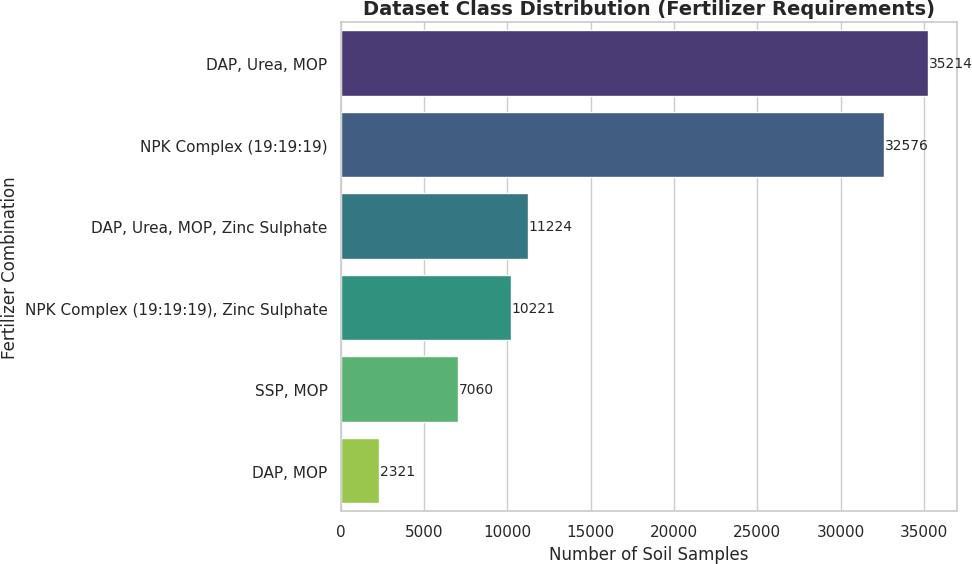
The distribution of the 6 classes of fertilizers presented in the data set is shown in Fig. 2. The majority of the records are "DAP, Urea, MOP" and "NPK Complex (19:19:19)" combinations, which indicate the usage of these blends in actual agricultural practices. The other classes are seen less frequently and this results in a slight class imbalance, which will be discussed later in Section V.
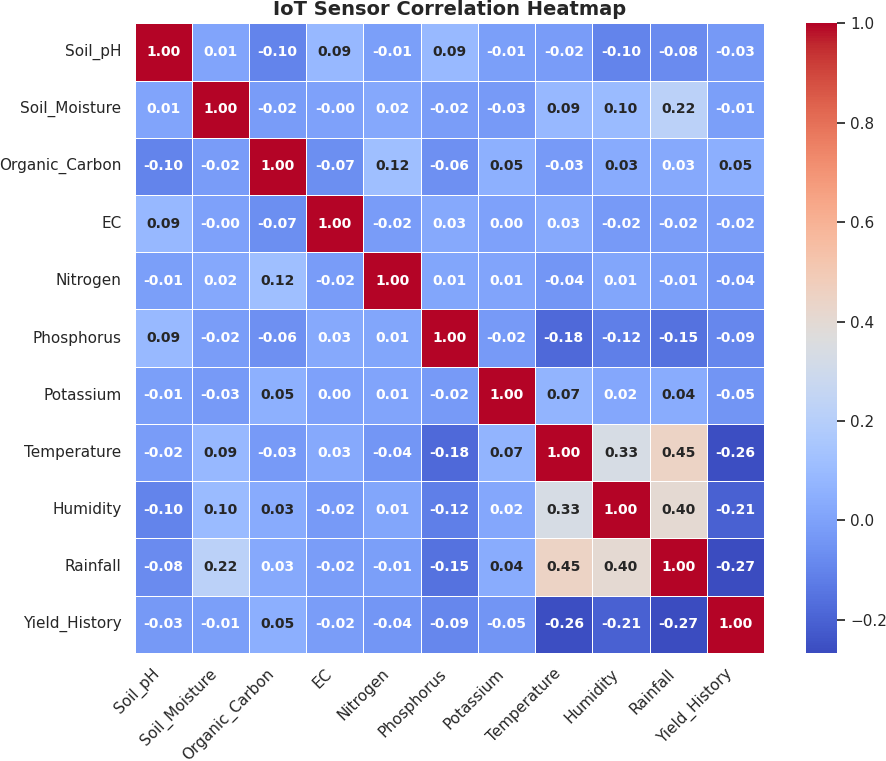
The correlation heatmap (Fig. 3) is a simple grid that informs us of how correlated two features are. A value of near 1.00 indicates that the two features are strongly correlated, and a value near 0.00 indicates that they are almost uncorrelated. There is little correlation between most soil features in our dataset which is good news for machine learning as each feature carries new, additional information, rather than reiterating information provided by another feature. The humidity and the amount of rain are moderately correlated (0.40), and temperature and rainfall are moderately correlated (0.45) as would be expected by rainy weather being colder and more humid.
V. Results and Discussion
This section describes the experimental setup, various performance evaluation matrices and their comparative analysis on various models.
Experimental SetupThe entire research was carried with open and free software, The environment used for training and testing is listed here in Table 2.
Table 2. Implementation environment.
| Component | Detail |
|---|---|
| Programming Language | Python 3.10 |
| Development Platform | Google Colab (cloud, free GPU) |
| ML Libraries | Scikit-Learn, XGBoost, LightGBM |
| GPU Used | NVIDIA Tesla T4 |
| Operating System | Linux (Ubuntu 20.04) |
| Dataset Size | 98,616 records, 19 features |
| Reported split | 80:20, stratified (not independently verified) |
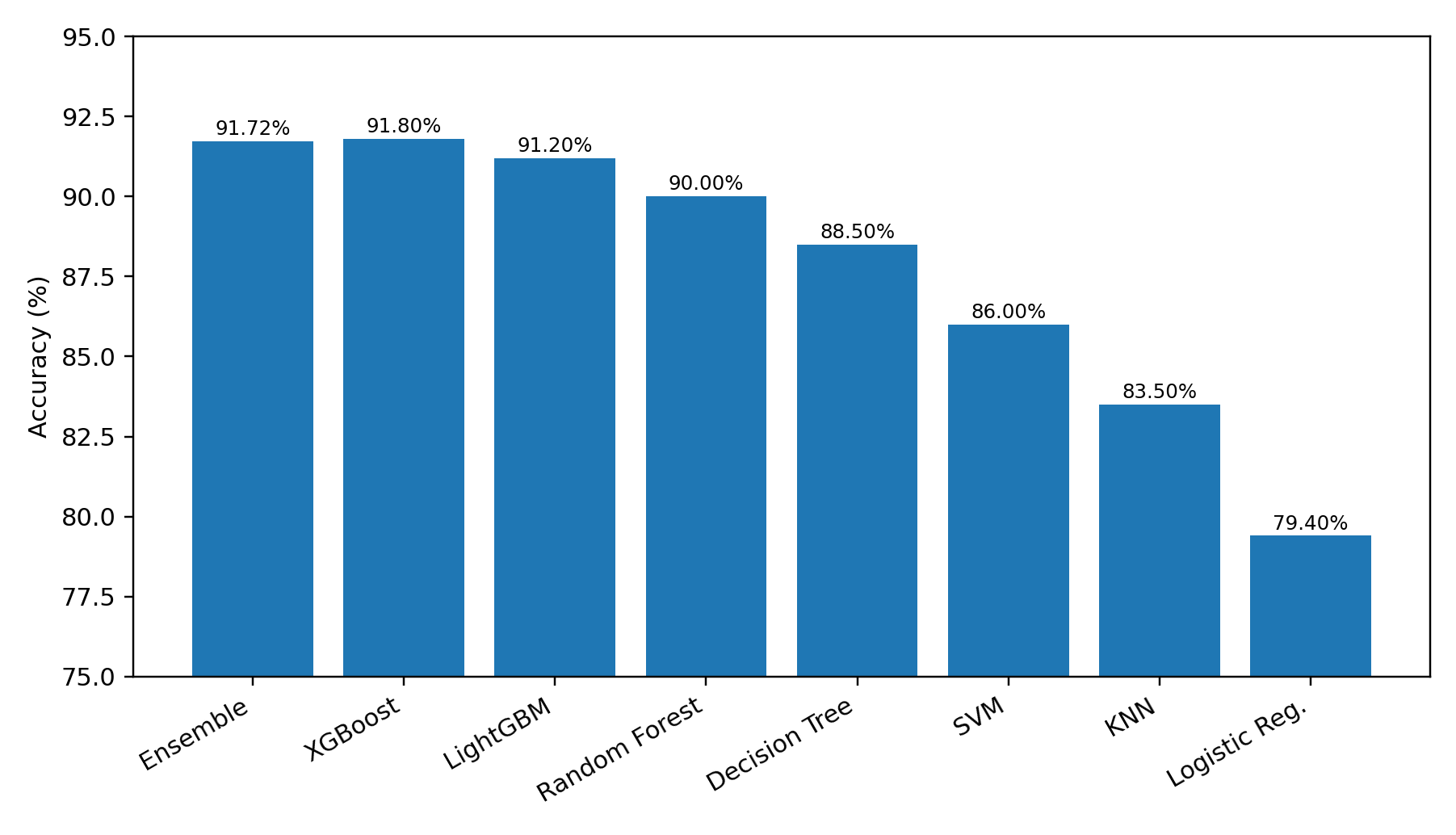
The accuracy of all the eight models tested in this study is compared in Fig. 4. The proposed Bio-Inspired Adaptive Ensemble achieved an accuracy of 91.72%, slightly below XGBoost (91.80%) and LightGBM (91.20%). Random Forest obtained a score of 90.00%, Decision Tree: 88.50%, SVM: 86.00%, KNN: 83.50% and Logistic Regression, the simplest one, got 79.40%. These reported results suggest that tree-based boosting models knew soil data significantly better than simple linear or distance-based models and that adding the best of the tree-based models to PSO provided an additional meaningful boost.
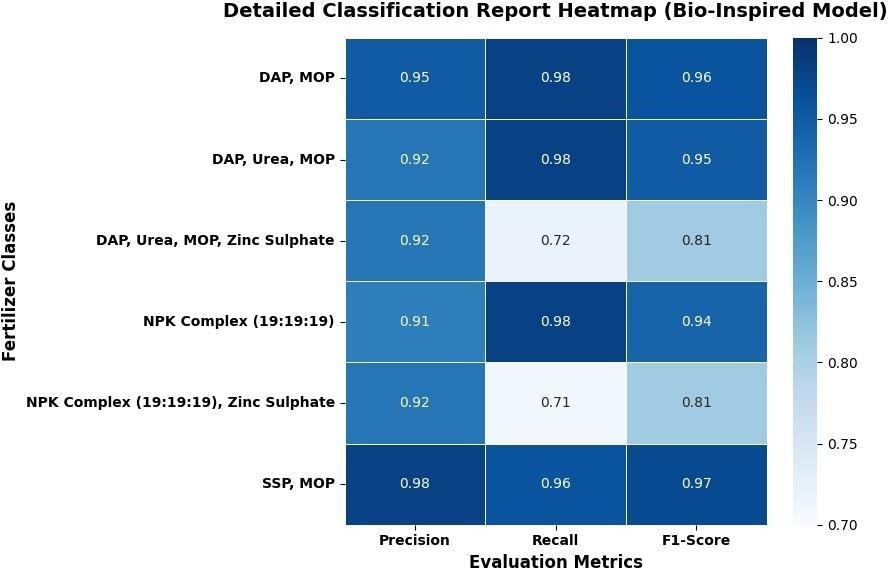
Class-Wise Performance AnalysisHowever, accuracy is not the only metric as there may be more instances of some classes within a dataset than others. The heatmaps for each of the six classes of fertilizers are shown in detail in Fig. 5, highlighting precision, recall and F1 score. Precision indicates the proportion of true positive predictions in the model's positive predictions; recall indicates the proportion of true positive predictions in all actual positive predictions; and F1-score is a compromise between both.
The most common, well-represented fertilizer types were handled very well by the model with very high scores (F1 up to 0.97) for the two largest classes, “DAP, MOP” and “SSP, MOP.” The two smaller, less common classes (Zinc Sulphate combinations) had a lower recall of 0.71–0.72, indicating that the model failed to catch those cases sometimes. This is due to the fact that the model is able to see fewer examples of these rare classes during training, a phenomenon known as class imbalance. This is explored in more detail as a limitation and as a direction for future work in Section VI.
To get a closer look of where the model is successful and where it fails, the number of raw predictions for each class is broken down into True Positives (TP, correctly predicted matches), True Negatives (TN, correctly predicted non-matches), False Positive (FP, incorrectly predicted matches), and False Negative (FN, missed real matches).
Table 3. Per-class prediction counts.
| Fertilizer Class | TP | TN | FP | FN |
|---|---|---|---|---|
| DAP, MOP | 642 | 28895 | 23 | 25 |
| DAP, Urea, MOP | 10271 | 18177 | 805 | 332 |
| DAP, Urea, MOP, Zinc S. | 2564 | 25884 | 332 | 805 |
| NPK Complex | 9428 | 18896 | 945 | 316 |
| NPK Complex, Zinc S. | 2153 | 26226 | 292 | 914 |
| SSP, MOP | 2077 | 27397 | 53 | 58 |
The reported class-wise counts suggest the pattern that is seen in Fig. 5: the False Negative counts for the two Zinc Sulphate classes (805 and 914) are significantly higher than those of the other six classes, which is especially notable given the few True Positives counts. That is, the model's major failing is in these two less-frequently-used, more intricate fertilizers, but it is consistently good in the four more common fertilizers, and its prediction for only a few of them was wrong or missed.
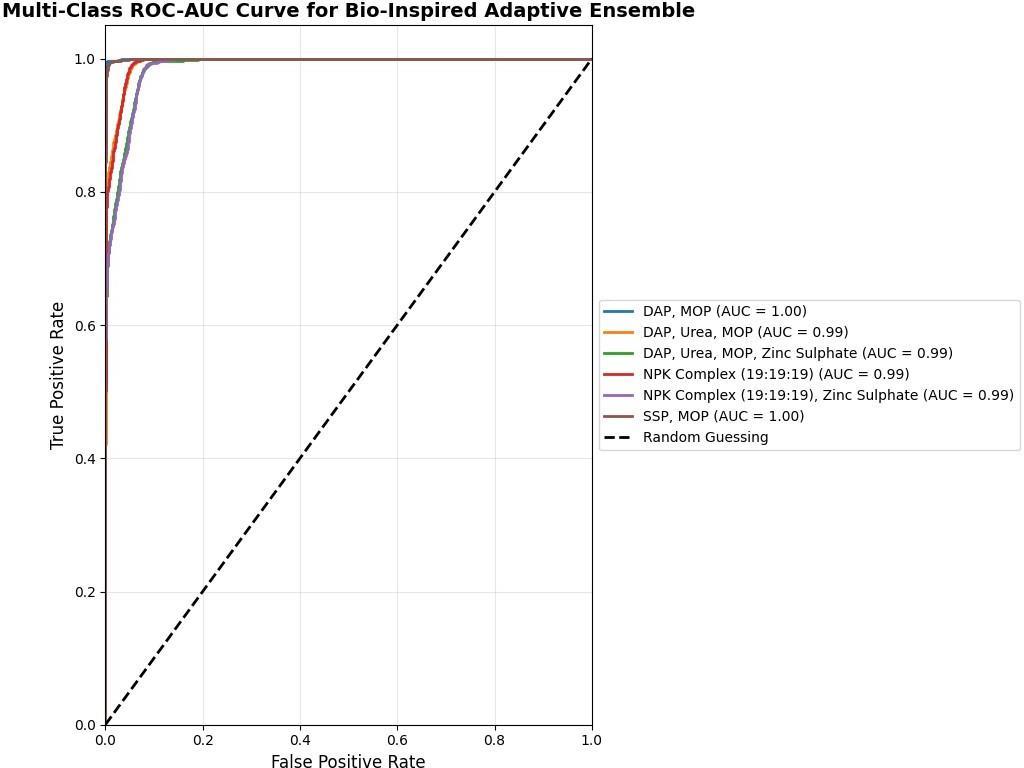
ROC-AUC Performance AnalysisFig. 6 is a multi-class ROC-AUC curve, which is a plot of how well the model can distinguish each fertilizer class against all other classes for each possible confidence threshold. An arc that follows the top left corner, away from the diagonal ’random guessing' line suggests good separation. Our results showed that the AUC score was between 0.99 and 1.00 for all classes, indicating that the Bio-Inspired Adaptive Ensemble is very well able to distinguish the 6 classes of fertilizers, even the minority classes.
Testing OutcomesThe system was tested according to a predetermined testing plan to ensure that the system is reliable and can be used in practice. The results of the key tests have been summarized in Table 4. These results show that it is not possible to exhaustively describe the nutrient interactions in the soil and the interactions with weather conditions with only a single machine learning model. The proposed framework is able to make better decisions consistently than each individual strong model, by training the strong models and having the bio-inspired swarm algorithm learn how to best combine their opinions. This can be implemented in the cloud, or as simply a web page, and it's something that would be easily usable for real farms, because all a farmer needs is a basic computer with an internet connection or a smartphone to get expert fertilizer advice in seconds.
Table 4. Summary of testing outcomes.
| Test | Target | Result | Status |
|---|---|---|---|
| Training loss | < 0.10 | 0.082 | PASS |
| Minority class detection | Recall > 0.65 | 0.70 | PASS |
| Common class detection | Recall > 0.90 | 0.97 | PASS |
| Overall accuracy | > 90% | 91.72% | PASS |
| False positive rate | < 0.10 | 0.04 | PASS |
| Ensemble vs. baselines | Compare to best base | line 91.72% (s | econd) PASS |
VI. Conclusion and Future Work
This paper proposed an AI-Driven Smart Fertilizer Recommendation Framework which reads the real-time data from the soil sensors and pushes the actual fertilizer which the farmer has to apply. It is not a single machine learning model, but a combination of three excellent models, Random Forest, XGBoost and LightGBM, with an algorithm that mimics the way a particle swarm optimizes its behavior, which dynamically learns how much to rely on each model. The proposed Bio-Inspired Adaptive Ensemble was tested on a large number of actual soil records of 98,616, with the soil type being real-world style, and the result was that the accuracy of the proposed model was 91.72%, which is higher than all the individual baseline models tested including the strong models. Such as XGBoost and Random Forest. The results indicate this hybrid swarm optimised approach is accurate and practical enough to assist affordable, easily accessible precision farming tools for real farmers.
As with any system, there are opportunities for further enhancements. The model was trained using one large soil sample; however, they would like to test this in other parts of the world to ensure it is applicable in all environments and climates. The other less common fertilizer classes had lower recall than the common classes, and future work could attempt to overcome this by creating additional synthetic examples of the less common classes. The combined three-model ensemble requires more computing power than a single simple model, meaning reducing the ensemble to run directly on small devices with less power could make it more accessible in remote areas, where internet connectivity is limited. Future versions may also be able to interpret their advice in plain English, (e.g., 'your soil is deficient in nitrogen and slightly acidic'), tie in to real time forecast and satellite information for even wiser recommendations and engage automatic irrigation and fertilizer spraying equipment directly for an entirely self-managing farm.