RoLL: Youth on a Roll, A Human-AI Co-Created Short Animation for Hesitating Youth
Abstract — RoLL is a coming-of-age short animation co-created with generative AI tools. Borrowing the phrase “roll with it,” it speaks to young people who cannot easily decide amid job preparation, information overload, and endless comparison: rather than waiting for the perfect choice, just go for it. A boy hesitating before a blank canvas is drawn onto roller skates by a playful girl, and the paint on their wheels finally colors the whole town. This paper describes its planning intent, symbolism, color and sound direction, and production process, based on the creator’s statement and the film.
Keywords — Human-Ai Co-Creation; Ai-Assisted Animation; Generative Ai; Visual Storytelling; Character Consistency;
I. INTRODUCTION
“Don’t wait for the perfect moment. Just go for it.” [1]
Today’s young adults face major choices while preparing for employment, surrounded by a flood of information and constant comparison with others.
RoLL starts from this state of youth. In English, “roll with it” means going along with the flow without fearing an unexpected situation too much. The film turns this phrase into a story of a first step for young people in that period [1].
The work also began as a personal one. The creator, who was worrying about employment herself, describes it as starting from the words she wanted to tell herself: “Just give it a try” [1]. This paper examines how that intent was translated into story, image, and sound, and how generative AI was used in an individual student production. Human-AI co-creativity has been described as humans and AI collaborating as partners on a shared creative product [2], and this paper treats RoLL as a case of such co-creation in student animation.
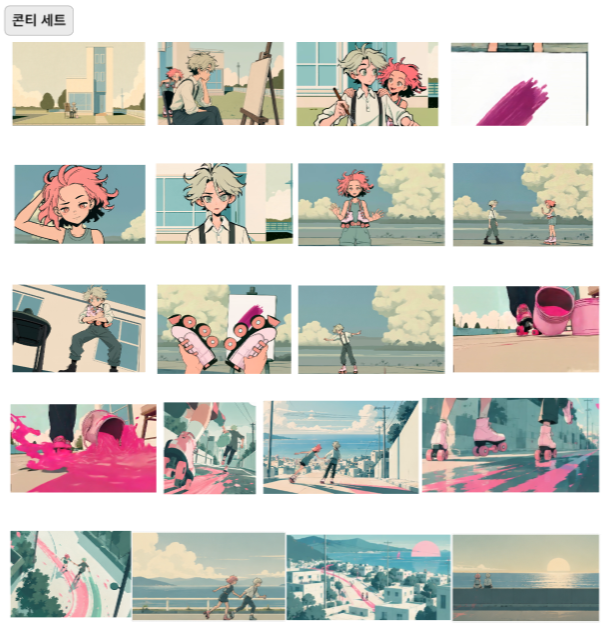
II. Narrative and Character Design
A. Synopsis
Two young people live in a small town, and one of them, a boy, hesitates before an empty canvas. A girl on roller skates sneaks up and surprises him, and he makes a mistake on the canvas. He gets frustrated and chases after her, and then she tosses him a pair of skates so they can ride together and playfully rolls away.
Hesitating between the canvas and the girl, he sets his worries aside and follows her. He cannot keep his balance at first; he falls and knocks over a can of paint. As the girl takes his hand and pulls him along, he gradually finds his pace, and the two begin to cross the town together. The film closes with the town colored by paint, the wider world becoming his canvas [1].
B. Two Characters
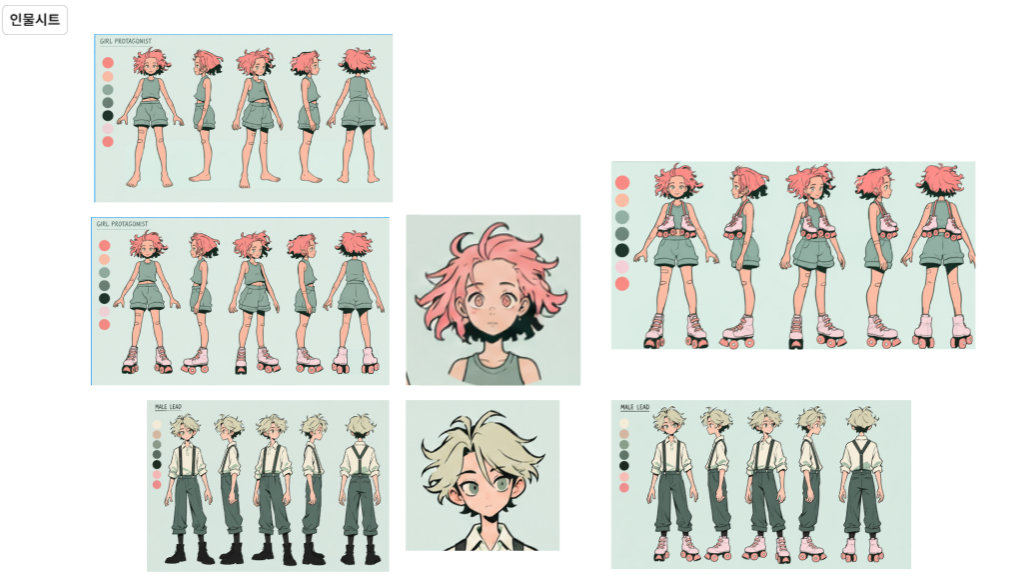
At the center of the work are two young people with different temperaments. The boy wants to paint but cannot easily lift his brush. The girl is mischievous and spontaneous, always rolling forward on her skates. They stand for hesitation and movement. Their appearance reflects this contrast: the boy, with pale blond hair, a white shirt, and muted green-gray trousers, belongs to the still palette of the town, while the girl’s pink hair and pink roller skates carry the color of impulse that later spreads across the canvas and the streets.
III. Directing Approach
A. Visual Metaphors: Canvas and Roller Skates
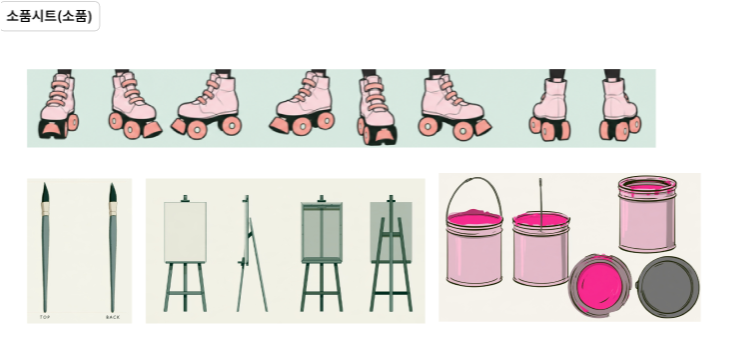
The two main motifs are the canvas and the roller skates. The canvas is more frightening because it is empty, and once something is drawn it is hard to undo; it symbolizes the uncertainty of the future and the burden of choice. Roller skates, in contrast, roll forward with only a small push, symbolizing a reckless but lively challenge. The boy keeps going despite falling because the girl helps him: youth is not completed alone but is a process of moving together [1].
B. Color
The visual mood was inspired by the work of Hiroshi Nagai, an illustrator known for the album covers of Japan’s city pop era, whose paintings center on crisp urban landscapes, tropical motifs, poolsides, and sunsets [3]. His influence is visible in the film’s flat color fields, clean white houses, tall summer clouds, and seaside light. The palette centers on the contrast between a near-achromatic green and pink: green-gray #6F8178 for stillness and hesitation, soft pink #F2A7B7 for vitality and impulse, off-white #F4F1EB for the unknown and the town as one large canvas, and deep pink #FF7FA2 for emotional climaxes [1].
In the film, pink first appears only as small accents in a muted world, such as a pink train in the opening landscape and the girl’s hair. The magenta stroke on the canvas is the first moment pink enters the boy’s space, and from then on it spreads with the movement of the characters.
C. Sound
In the first part, sound effects are placed at the center instead of music to keep a sense of emptiness and tension. After the boy decides to ride the skates, fast-beat jazz-pop amplifies the speed and the feeling of release [1]. In the film, the music rises as the girl throws the skates and continues until the final shots of the town.
D. The Town as a Canvas
At the end, the paint on the skate wheels spreads until it colors the whole town, an abstract animated expression in which the town expands into one huge canvas [1]. Pink lines run along the coastal roads and through every street under a pink sun. The boy no longer agonizes over a perfect start in front of a small canvas; moving with the girl, he naturally leaves his own color on the world.
IV. Production Process
Production proceeded in the order of theme setting, scenario writing, storyboard, character and scene sheets, image generation, video generation, and editing with sound [1]. Starting from the keyword “youth,” the creator set an emotional axis from anxiety to challenge, and a text storyboard became the basis for consistency sheets.
Midjourney was used to create the character and prop sheets, defining the impression and costumes of the main characters and the mood of the props. ChatGPT helped arrange the scene sheets and scene descriptions, organizing the flow of cuts and the visual information each one needed. Kling turned the generated images into short movements and scene transitions, and final editing and sound were done in Premiere Pro [1].
V. Reflection
The most meaningful moment during the work was the time when the students spent reviewing and discussing each other’s work. Since they each used AI differently, they shared prompts and know-how for character consistency and the motion they had in mind. Although it was an individual work, the process never felt entirely solitary [1].
No one started out knowing the right answer, yet on the day they submitted their works to the AAFF competition, they all went home deeply moved. Just as roller skates can be unstable alone but move forward when someone holds your hand, the creator describes having experienced youth through this process of connection and solidarity [1]. The making of RoLL thus repeated the story the film tells.
VI. Conclusion
RoLL is a short coming-of-age animation that tells hesitating youth not to wait for the perfect moment but to go for it. Through contrasts of canvas and skates, green-gray and pink, and silence and jazz-pop, the film turns a small accident into motion and the whole town into a canvas.
The work also shows a practical form of human-AI co-creation. The creator set the theme, wrote the story, designed the motifs and palette, and made every final selection, while Midjourney, ChatGPT, and Kling visualized the characters, organized the scenes, and generated motion. Reference sheets kept the AI outputs consistent with the creator’s intent, and knowledge shared among peers turned an individual project into a collaborative learning process. In this co-creation, AI expanded what a single student could produce, but the meaning of the work came from the creator’s own question and from the people who moved forward with her.
Acknowledgments. This research was supported by the Gyeongbuk ANCHOR system through the Gyeongbuk ANCHOR CENTER, funded by the Ministry of Education (MoE) and Gyeonsangbuk-do, Republic of Korea (2026-ANCHOR-15-107).
References
[1] S. Yoon, “A Study on the Production of the AI Short Animation RoLL,” unpublished, 2026.
[2] J. Rezwana and M. L. Maher, “Designing creative AI partners with COFI: A framework for modeling interaction in human-AI co-creative systems,” ACM Trans. Comput.-Hum. Interact., vol. 30, no. 5, pp. 67:1–67:28, 2023.
[3] The Japan Foundation, Sydney, “Hiroshi Nagai: Paintings for Music,” exhibition, Sep. 2020–Jan. 2021. [Online]. Available: https://sydney.jpf.go.jp/?p=27263