From Psychological Restoration Evidence to AI-Assisted Spatial Design Criteria: A Preliminary Evaluation Framework for Neighborhood Public Spaces
SHUI CAO*, Department of Design, Graduate School, Dongseo University
Busan, Korea (south), caoshui0710@gmail.com
Kwan-seon Hong**, Department of Design, Graduate School, Dongseo University
Busan, Korea (south), cigahks@naver.com
* Corresponding author
Abstract — Neighborhood public spaces are recurring settings for everyday activity, brief psychological restoration, and community relations. Yet evidence on environmental qualities, observed behavior, social cohesion, and restorative perception is usually generated in separate research traditions and is difficult to translate into testable design criteria. This conceptual study integrates restorative-environment theory, secondary evidence from recent systematic reviews, computational urban research, and an official-document comparison of three Chinese neighborhood-renewal cases. It proposes a human-in-the-loop framework with four linked layers: spatial design conditions, behavior settings, social cohesion, and perceived psychological restoration. Spatial conditions comprise openness/accessibility, naturalness, stay support, and interaction support; restoration is represented by relaxation, comfort, stress relief, and emotional stability. Geographic information systems, visual-language models, semantic segmentation, and privacy-preserving computer vision may scale the description of spatial and behavioral evidence. Resident ratings and human review remain the criterion for social and psychological meaning. Caoyang New Village, Jinsongbei Community, and Minzhu Village illustrate nature-mobility, service-encounter, and participation-belonging pathways, respectively, without demonstrating resident-level psychological effects. The framework converts evidence into conditional, falsifiable design statements and specifies a three-stage validation protocol. Its contribution is to position AI as an auditable evidence-enhancement layer rather than a substitute for residents in restorative design evaluation.
Keywords — Neighborhood Public Space; Perceived Psychological Restoration; Spatial Design Criteria; Human-In-The-Loop Ai
I. Introduction
High-density urban life concentrates attentional fatigue, environmental stress, and social disconnection within the settings of everyday residence. Compared with destination parks, internal walkways, pocket greens, resting nodes, play areas, and multi-purpose courtyards in residential neighborhoods are near, frequently used, and entered with little planning. Their public-health value may therefore lie in repeated micro-restoration rather than occasional immersion. Attention Restoration Theory (ART) proposes that being away, soft fascination, extent or coherence, and compatibility can support the renewal of directed attention; Stress Recovery Theory (SRT) emphasizes affective and physiological stress reduction following exposure to supportive environmental cues [1], [2]. The Perceived Restorativeness Scale (PRS) and PRS-11 operationalize the perceived restorative quality of environments [3], [4]. Nevertheless, theoretical qualities are not design instructions. Adding vegetation, seats, or programmed activity does not necessarily produce restoration when traffic noise, heat exposure, crowding, maintenance problems, or forced interaction remain unresolved.
The central problem is evidence fragmentation. Dong et al. retained 30 multisensory studies of public urban space; visual-auditory combinations were the largest group, and 87% of the included studies had appeared in the preceding five years [5]. Their synthesis indicates that sensory inputs may be additive, compensatory, synergistic, or antagonistic. A bench placed beside heavy traffic, for example, may technically support staying while reducing comfort. Qi et al. reviewed 63 empirical studies published between 2000 and 2023 on public space and social cohesion [6]. Accessibility, mixed use, and street furniture were among the physical characteristics associated with interaction, yet physical form, behavior, perception, and cohesion remained divided among disciplines. Field observation was used in 34 studies and 40% examined behavioral outcomes. Together, these reviews suggest that a restorative design framework must connect what a space affords, how it is used, what social relations are perceived, and whether residents report restoration.
Artificial intelligence (AI) expands the scale and temporal coverage of the first two questions. Computer vision has been used to identify pedestrian attributes and fine-grained behavior in community outdoor spaces [7]. Street-view imagery, deep learning, and spatial models can map heterogeneity in restorative street perception [8], [9]. More recently, Ma and Kwan combined PRS-11 ratings and scene descriptions as prior knowledge for visual-language-model (VLM) assessment of urban space [10]. That study also documented important limits: restricted viewpoints, weak representation of seasonal and dynamic conditions, missing nonvisual senses, and possible cultural bias. Thus, an AI system that directly substitutes for residents can gain spatial coverage while losing construct validity.
This paper asks how psychological-restoration evidence can be translated into operational neighborhood-space criteria while defining the tasks that AI may support but not replace. It makes three contributions. First, it proposes a four-layer evidence chain linking spatial design conditions, behavior settings, social cohesion, and perceived psychological restoration while retaining a direct spatial/behavioral association with restoration. Second, it translates four environmental dimensions into observable measures and conditional criteria. Third, it specifies a human-in-the-loop protocol in which AI scales spatial and behavioral evidence and resident data anchors social and psychological interpretation.
II. METHOD AND EVIDENCE BOUNDARIES
This is a framework-building exploratory study, not a new systematic review or an outcome evaluation. The method had three steps. First, concepts from ART, SRT, PRS research, and the public-space/social-cohesion literature were integrated to identify testable links among environment, behavior, social experience, and restoration. Second, two recent systematic reviews and four representative computational studies were synthesized in an evidence matrix organized by spatial variable, behavioral process, perceived outcome, technical capability, and limitation. Only statistics reported by the original reviews are reproduced; primary articles were not re-coded and effect sizes were not pooled. Third, three neighborhood-renewal projects were purposively selected from authoritative public documentation. The cases emphasize a continuous green walking network (Caoyang New Village, Shanghai), everyday services and encounters (Jinsongbei Community, Beijing), and participatory renewal and place belonging (Minzhu Village, Chongqing). The cases test the coverage and interpretability of the framework. They do not establish comparative performance or resident-level psychological change.
Table 1. SECONDARY EVIDENCE BASE AND DESIGN IMPLICATIONS
Aspect
Ma and Kwan [10]
This study
Unit
Citywide street-view image
Neighborhood-internal space-time episode
Outcome model
PRS-11 restorative quality as VLM output
Spatial → behavior → social cohesion → separate PRS-11 / affect outcomes
VLM position
Human knowledge anchors automated scores
Only spatial/behavior pre-coding; resident outcomes outside loop
Evidence status
Empirical: 566 anchors + 2,224 images; ΔR²=0.535
Conceptual: secondary evidence + stress tests; no resident-effect claim
III. PRELIMINARY AI-ASSISTED FRAMEWORK A. Four-Layer Evidence Chain
A. Four-Layer Evidence Chain
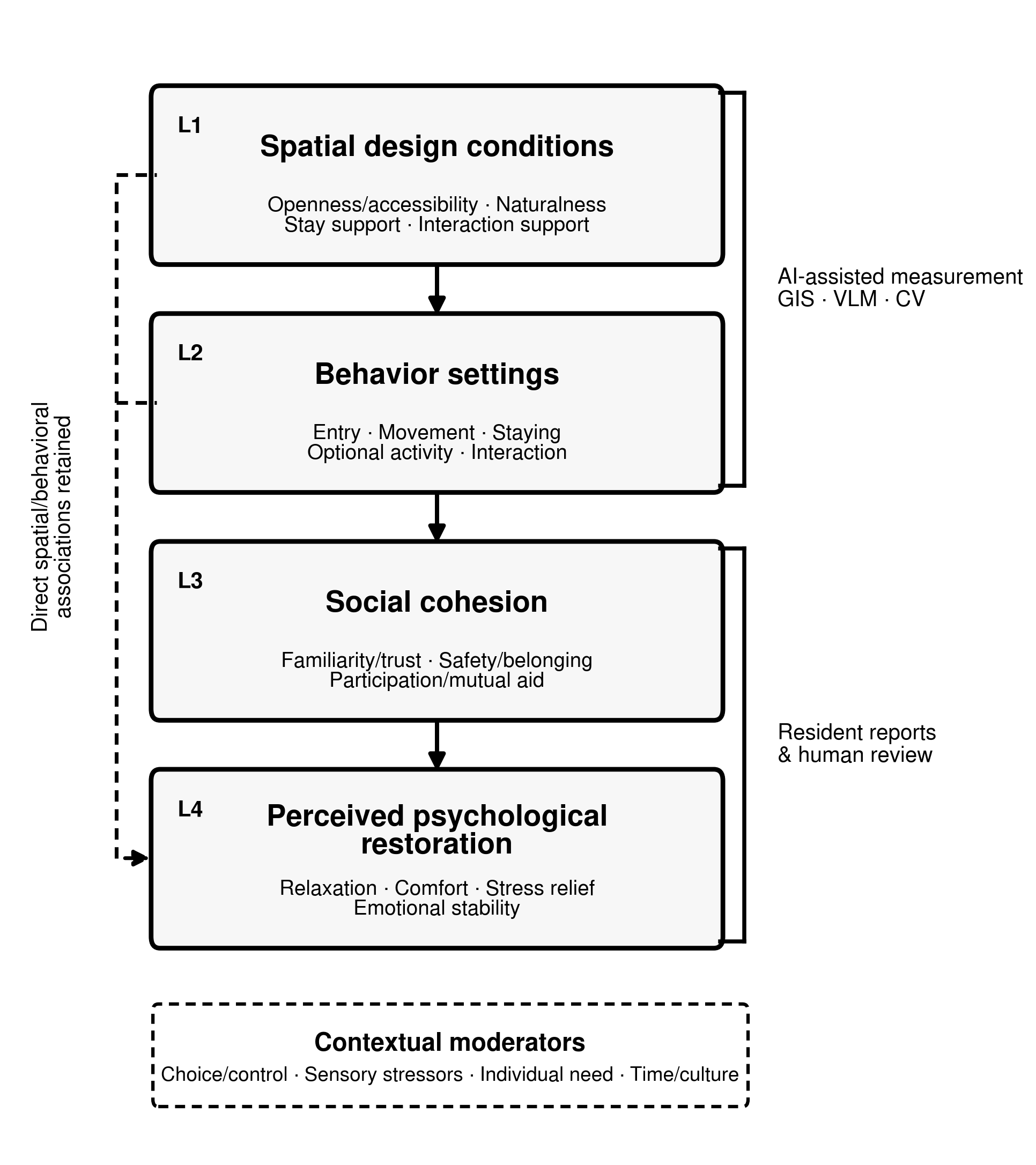
The first layer is spatial design conditions: openness/accessibility, naturalness, stay support, and interaction support. The second is behavior settings, defined as recurring combinations of spatial affordances, user groups, activities, and time. It records entry, movement, staying, optional activity, and interaction rather than treating footfall as sufficient evidence of quality. The third layer is social cohesion, operationalized through familiarity/trust, perceived safety/belonging, and participation/mutual aid. The fourth is perceived psychological restoration, represented in this preliminary framework by relaxation, comfort, stress relief, and emotional stability. These terms are deliberately used as perceptions rather than proven cognitive or physiological recovery.
The proposed associations are conditional. Spatial conditions may relate to restoration indirectly through behavior settings and social cohesion, while a direct association is retained for experiences such as natural exposure, sensory relief, legibility, or perceived safety. Social contact is not assumed to be universally restorative. The ability to choose between quiet withdrawal, observation, and low-intensity interaction is treated as a shared boundary condition for stay and interaction support. This prevents the common but invalid inference that more activity or more contact necessarily means more recovery.
Figure 1. Human-AI evidence chain and resident calibration boundary.
B. Indicators and Design Translation
Openness/accessibility concerns pedestrian-network continuity, entrance permeability, visual legibility, barrier-free movement, and network distance to everyday services. The corresponding criterion is a recognizable, low-resistance, multi-route access system, not unlimited openness. Naturalness covers visible greenery, canopy and shade, water or seasonal variety, natural sound, and thermal buffering. Its criterion is coordinated visual, auditory, and thermal relief; greening is not used as a proxy for the whole experience. Stay support includes the number and arrangement of seats, shade and rain cover, quiet micro-spaces, maintenance, and adjustability. It should provide options for different durations, exposure levels, and social intensities. Interaction support includes face-to-face or movable seating, active edges, mixed everyday services, age inclusivity, and resident participation. Its criterion is to enable low-threshold encounters and repeated co-presence without compelling interaction.
Each dimension produces three data types. Spatial measures retain their native units, such as network distance, entrance count, green-view ratio, shaded-seat provision, or service mix. Behavioral measures use time-sampled maps, dwell time, optional-activity counts, and co-presence patterns. Resident outcomes use rating items for social cohesion and perceived restoration. No fixed weight, universal threshold, or total score is proposed at this stage. Aggregation before validation would convert context-sensitive associations into false standards. Following a pilot, comparable site types may be standardized, but aggregation should depend on reliability, factorial validity, measurement invariance, and model fit.
Table 2. DIMENSIONS, MEASURES, AND CONDITIONAL DESIGN CRITERIA
Offer choice in duration, exposure, and social intensity
Interaction
Seat orientation, active edge, services, inclusion; co-presence analysis
Support repeated low-threshold encounters, not forced contact
C. Human-AI Task Boundary
Appropriate AI tasks include GIS-based walkability and connectivity analysis; semantic segmentation or VLM pre-coding of greenery, sky, interfaces, furniture, and shade; privacy-preserving computer vision for flow, dwell time, and small-group co-presence; and flags for disagreement between human coders or unusual temporal patterns. A sampled human audit should report accuracy, omissions, and group-specific error. AI should not infer stress, trust, belonging, or restoration directly from faces, postures, or dwell time, nor should a generated “resident” be treated as a participant. Social cohesion and restoration require ethically reviewed resident questionnaires, interviews, and, where appropriate, complementary physiological or behavioral measures. Video protocols should minimize collection, remove identity, limit retention, and preserve accountable human oversight, consistent with UNESCO principles of privacy, transparency, fairness, and human determination [11]
D. Evaluation Unit and Decision Rule
The basic evaluation unit is a space-time episode rather than an undifferentiated site average: a defined spatial segment, a sampling period, a user context, and a documented environmental state. The same courtyard may provide quiet refuge on a weekday morning and become thermally exposed or socially congested in the afternoon. For each episode, a mechanism card records (1) the spatial condition and its provenance, (2) the behavior setting expected or observed, (3) the resident-reported social and restorative outcomes, (4) relevant moderators such as noise, heat, mobility limitation, or desire for solitude, and (5) an explicit disconfirmation condition. AI-derived variables carry model version, confidence, image or sensor coverage, and human-audit results; resident variables carry sampling and scale information. This structure preserves traceability from a design statement to its evidence instead of collapsing unlike observations into a single opaque score.
At the preliminary stage, each criterion is coded as supported, contradicted, indeterminate, or not observed within the sampled episode. “Supported” requires aligned spatial, behavioral, and resident evidence; a favorable spatial feature alone is insufficient. “Contradicted” records an expected mechanism that is absent or paired with an adverse resident response. “Indeterminate” is used when layers disagree or evidence quality is inadequate, preventing missing data from being interpreted as success. Results should be displayed as a criterion profile with uncertainty and subgroup notes, not as a league table of neighborhoods. A composite score may be considered only after construct validity, cross-context invariance, and the consequences of weighting choices have been examined with residents and domain experts.
IV. CROSS-CASE DEMONSTRATION
The three cases demonstrate how the same dimensions may combine into different mechanisms. Official project descriptions are evidence of design and governance conditions, not psychological outcomes; therefore, no score, ranking, or causal claim is assigned.
Table 3. CASE CONDITIONS, MECHANISMS, AND OUTCOMES TO BE TESTED
Case
Documented spatial/governance condition
Interpretive mechanism and test
Caoyang
15-minute life circle; waterfront green loop connects walking routes and nodes
Nature-mobility: repeated walking/brief stays; test relaxation and stress relief
Jinsongbei
One street, two parks, two cores, multiple nodes; public space plus services
Service-encounter: repeated co-presence/weak ties; test trust and comfort
Minzhu
Resident consultation; retain-renovate-demolish-add; community living room
Participation-belonging: co-decision/place memory; test belonging and stability
Adverse boundary
Beijing Olympic Boulevard: 1.4 km; no shade or sitting; umbrella workaround [18]
Stay support contradicted spatial-behaviorally; restoration indeterminate
Caoyang New Village follows a 15-minute community-life-circle approach. Its waterfront green loop connects pedestrian routes and public nodes [12]. The framework reads this as a nature-mobility pathway: continuity and natural exposure may support frequent walking and brief stays, after which resident data must test associations with relaxation and stress relief. Jinsongbei Community was renewed around “one street, two parks, two cores, and multiple nodes,” combining public-space improvements with service provision and community culture [13]. This suggests a service-encounter pathway in which daily functions and supported staying may increase repeated co-presence and weak-tie opportunities. Whether encounter becomes trust, comfort, or restoration remains an empirical question. Minzhu Village brought planners, architects, and engineers into dialogue with residents and used a retain-renovate-demolish-add strategy to preserve place memory; a community living room became a social-service node [14]. This supports a participation-belonging hypothesis. AI may compare the cases' spatial and behavioral patterns, but cultural memory, participation quality, and psychological meaning still require situated resident interpretation.
Comparison across the three pathways clarifies that the four dimensions are neither interchangeable nor uniformly beneficial. Caoyang foregrounds route continuity and multisensory natural exposure, but the hypothesis fails if the green loop remains inaccessible to mobility-limited residents or if heat and noise suppress comfortable staying. Jinsongbei foregrounds service adjacency and repeated encounters, but high co-presence cannot stand in for trust and may burden residents seeking privacy. Minzhu foregrounds participation and place memory, yet the number of meetings or retained structures does not establish meaningful influence or belonging. The framework therefore asks the same cross-case questions—who can enter, who can remain comfortably, what contact can be chosen, and whose interpretation counts—while allowing different spatial mechanisms to be tested. This is more informative than assigning cases to a universal restorative ranking.
V. DISCUSSION AND VALIDATION PATH
Three translation rules make the framework falsifiable. First, a criterion must state a spatial condition, an expected behavioral process, and a resident outcome. “Place continuous vegetation and optional quiet seats on the traffic-exposed edge to support comfortable short stays” is testable; “add greenery” is not. Second, a criterion must include a plausible disconfirmation. If green visibility rises but noise, heat, or crowding also rises and restoration ratings do not improve, the naturalness criterion requires revision. If more interaction nodes reduce opportunities for solitude and perceived stress rises, interaction support cannot be classified as beneficial. Third, an AI measure must be compared with a human reference and report errors across user groups, time periods, and cultural settings. These rules shift design guidance from universal prescriptions to conditional propositions that can survive or fail empirical tests.
Validation is proposed in three stages. Stage 1 uses a Delphi process to rate indicator relevance, importance, and clarity, process open comments, and produce a bilingual coding manual. Stage 2 conducts a pilot across contrasting neighborhood-space types. GIS and field measurements are combined with time-sampled behavior mapping, de-identified visual counts, and resident questionnaires. Human-AI coding agreement and the reliability and factorial validity of the social and restoration measures are assessed. Stage 3 applies multilevel regression or structural equation modeling to the proposed associations among spatial conditions, behavior settings, social cohesion, and perceived restoration. Measurement invariance should be examined across age groups, space types, and cultural contexts. Weights, thresholds, or graded design standards should be discussed only after replication across sites.
Table 4. PROPOSED VALIDATION STAGES AND DECISION GATES
Stage
Evidence task
Decision gate
1: content
Delphi review; resident language check; coding manual
Retain clear, relevant, non-duplicative criteria
2: pilot
GIS/field/behavior/resident data; human-AI audit
Adequate agreement, reliability, validity, and feasibility
3: model
Multilevel/SEM tests; subgroup and context invariance
Replicated associations before weights or standards
The decision gates are deliberately methodological rather than numerical because universal cutoffs would be premature. Stage 1 should remove indicators that experts or residents cannot interpret consistently and document minority objections instead of averaging them away. Stage 2 should pre-register sampling windows, report missingness and subgroup error, and compare AI outputs with blinded human coding on a held-out sample. Disagreement is diagnostic: systematic under-detection of children, older adults, assistive-device users, or quiet forms of co-presence indicates that the automated measure is not fit for evaluation. Stage 3 should compare direct, mediated, and moderated models rather than assuming that social cohesion always mediates restoration. Sensitivity analyses should show how conclusions change across alternative spatial boundaries, time windows, and weighting schemes. These gates convert the framework from an attractive diagram into a sequence of claims that can be rejected, revised, or transferred with known uncertainty.
The framework also clarifies how this study differs from fully automated restorative-perception mapping. VLMs can identify a broad range of visible design features and, when anchored with human labels, can improve spatial coverage [10]. They cannot observe off-camera social history, voluntary participation, smells, thermal adaptation, or the private meaning of a familiar place. Keeping resident outcomes outside the automated scoring loop protects the construct from being silently redefined as whatever a model can see. This is especially important in neighborhood research, where the same physical form may support refuge for one group and exclusion for another.
Several limitations remain. The paper relies on secondary evidence and positive-leaning project documentation rather than site observation or resident data. All three cases are Chinese and cannot represent other cultural or governance settings. Directionality, weights, predictive validity, and the role of individual need for restoration are untested. Computer-vision performance may be degraded by occlusion and unequal representation, while street-view and VLM assessments remain primarily visual. The present output should therefore be read as a set of hypotheses, an operational coding structure, and a validation protocol—not as a completed evaluation instrument.
VI. CONCLUSION
This study advances neighborhood restorative-space evaluation from isolated environmental features to a four-layer evidence chain linking spatial design conditions, behavior settings, social cohesion, and perceived psychological restoration. Openness/accessibility, naturalness, stay support, and interaction support are translated into observable conditions without assuming universal weights or thresholds. The AI contribution is deliberately bounded: GIS, image understanding, and de-identified behavior analysis improve the scale, repeatability, and diagnostic resolution of spatial-behavioral evidence, while resident evaluation and human review anchor social and psychological meaning. The three cases demonstrate the framework's capacity to interpret nature-mobility, service-encounter, and participation-belonging pathways, but not to prove restoration. The resulting framework provides a basis for context-sensitive, auditable, and falsifiable spatial design criteria in subsequent empirical research.
supported by BK21 Four Service Design driven Social Innovation Educational Research Team in Dongseo University.
References
[1] S. Kaplan, “The restorative benefits of nature: Toward an integrative framework,” J. Environ. Psychol., vol. 15, no. 3, pp. 169–182, 1995
[2] R. S. Ulrich, R. F. Simons, B. D. Losito, E. Fiorito, M. A. Miles, and M. Zelson, “Stress recovery during exposure to natural and urban environments,” J. Environ. Psychol., vol. 11, no. 3, pp. 201–230, 1991
[3] T. Hartig, K. Korpela, G. W. Evans, and T. Gärling, “A measure of restorative quality in environments,” Scand. Hous. Plan. Res., vol. 14, no. 4, pp. 175–194, 1997
[4] M. Pasini, R. Berto, M. Brondino, R. Hall, and C. Ortner, “How to measure the restorative quality of environments: The PRS-11,” Procedia Soc. Behav. Sci., vol. 159, pp. 293–297, 2014
[5] W. Dong, D. Dai, P. Shen, R. Zhang, and M. Liu, “How public urban space enhance restoration benefits through combined multisensory effects: A systematic review,” Land, vol. 13, no. 12, Art. no. 2018, 2024
[6] J. Qi, S. Mazumdar, and A. C. Vasconcelos, “Understanding the relationship between urban public space and social cohesion: A systematic review,” Int. J. Community Well-Being, vol. 7, pp. 155–212, 2024
[7] L. Wang and W. He, “Analysis of community outdoor public spaces based on computer vision behavior detection algorithm,” Appl. Sci., vol. 13, no. 19, Art. no. 10922, 2023
[8] X. Han, L. Wang, J. He, and T. Jung, “Restorative perception of urban streets: Interpretation using deep learning and MGWR models,” Front. Public Health, vol. 11, Art. no. 1141630, 2023
[9] Y. Wu, Q. Liu, T. Hang, Y. Yang, Y. Wang, and L. Cao, “Integrating restorative perception into urban street planning: A framework using street view images, deep learning, and space syntax,” Cities, vol. 147, Art. no. 104791, 2024
[10] H. Ma and M.-P. Kwan, “Measuring the psychological restorative quality of urban spaces: A vision language model-based method,” Sci. Rep., vol. 16, Art. no. 16534, 2026
[11] UNESCO, Recommendation on the Ethics of Artificial Intelligence, 2021. [Online]. Available: https://www.unesco.org/en/artificial-intelligence/recommendation-ethics. Accessed: Aug. 11, 2026.
[12] Shanghai Putuo District Planning and Natural Resources Bureau, “Excellent practice case of Shanghai urban renewal—Caoyang Community (including Caoyang New Village, Caoyang No. 1 Village, and Baixi Park): Revitalizing a workers’ new village” [“上海城市更新优秀实践案例|曹杨社区(含曹杨新村、曹杨一村、百禧公园):工人新村焕活密码”], Nov. 26, 2025, in Chinese. [Online]. Available: https://www.shpt.gov.cn/gtj-zfbm/tpxinwen-gtj/20251126/965414.html. Accessed: Aug. 13, 2026.
[13] Beijing Municipal Commission of Planning and Natural Resources, “Typical case—The ‘Jinsong model’” [“典型案例——‘劲松模式’”], Jun. 1, 2020, in Chinese. [Online]. Available: https://ghzrzyw.beijing.gov.cn/zhengwuxinxi/zxzt/zysj/msycc/ljxqzhzz/202006/t20200601_1912500.html. Accessed: Aug. 13, 2026.
[14] Minsheng Weekly, People’s Daily, “Chongqing Minzhu Village: Renewal and reshaping of an old community” [“重庆民主村:老旧社区焕新重塑”], May 27, 2024, in Chinese. [Online]. Available: https://paper.people.com.cn/mszk/html/2024-05/27/content_26061016.htm. Accessed: Aug. 13, 2026.